
1. The Autonomy Paradox: When Must an Agent Ask Permission?
Autonomous multi-agent architectures promise complete end-to-end automation. But in enterprise systems, unconstrained autonomy is an existential business risk. If an autonomous customer-support swarm can issue refunds, a single hallucinated prompt or edge case could issue hundreds of thousands of dollars in invalid credits.
The industry standard for solving this is Human-in-the-Loop (HITL) Gating: the agent retains complete autonomy over non-destructive, exploratory tasks (searching databases, summarizing documents, drafting proposals), but is architecturally prevented from committing destructive or high-liability mutations without an authorized human signature.
On a ballistic missile submarine, launching a missile cannot be completed by one person alone—not even the commanding officer. The launch system requires two separate physical keys located in different compartments, turned simultaneously within a 2-second window.
In multi-agent systems, Dual-Key Approval works the exact same way:
- Key 1 (The Agent's Proposed Action): The agent produces a structured, typed parameter payload (e.g. "Send $4,500 invoice payment to Vendor X").
- Key 2 (The Human's Cryptographic Token): An authorized human reviewer reviews the proposed payload in a secure dashboard and signs it with a cryptographic token.
Without Key 2, the execution tool sink remains completely physically and cryptographically locked.
2. Architectural Blueprints: Dual-Key Gateways & Approval Queues
Traditional interactive applications implement approvals via simple blocking HTTP calls. In distributed agent clusters, blocking is unacceptable—an agent cannot hold a live GPU thread or HTTP connection open for 45 minutes while a manager finishes a meeting and clicks "Approve" in Slack.
Instead, production architectures use Durable State Suspension & Asynchronous Resumption:
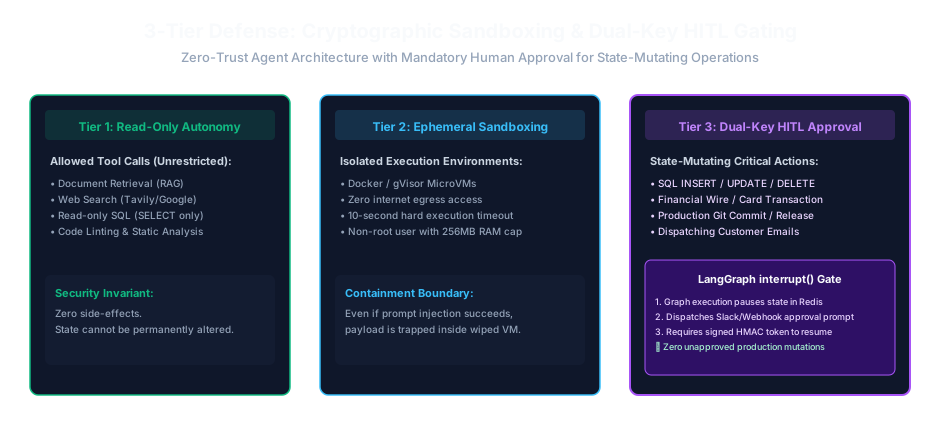
When an agent reaches a Tier 3 action (e.g., executing a database write or executing an API mutation), the orchestration engine saves the full state graph into a persistent checkpoint store (PostgreSQL or Redis) and raises an interrupt(). The compute worker is freed immediately.
Why can't we simply keep state in memory?
- Process Restarts & Pod Evictions: In Kubernetes environments, pods can be evicted or rescheduled at any moment. In-memory suspended tasks are lost forever.
- Audit Compliance (SOC2 / HIPAA): Regulated industries require immutable records of exactly what prompt state was shown to the human operator at the exact second approval was granted.
- Thread Concurrency: By decoupling state storage into a durable Postgres checkpointer (
PostgresSaverin LangGraph), thousands of approval requests can sit in queue concurrently without consuming inference compute.
3. Mathematical Formalism: Nonce Signatures & Time-To-Live (TTL) Decay
A common security vulnerability in naive HITL implementations is the Approval Replay Attack: an attacker observes a valid approval token for a $100 transfer and re-submits that exact payload multiple times.
To prevent replay attacks, each approval token must be cryptographically bound to a unique single-use nonce $N_i$ and a strict Time-to-Live (TTL) timestamp $t_{\text{issued}}$:
When the execution node resumes, it enforces a two-predicate cryptographic gate:
If the token signature fails, if the token is older than $\Delta t_{\text{TTL}}$ (typically 15 minutes), or if the nonce $N_i$ was previously seen in the consumed set $\mathcal{S}_{\text{used}}$, the execution node unconditionally halts and revokes worker permissions.
- Stage 1 (Action Identification): Agent formulates a state-changing tool call:
refund_customer(user_id=108, amount=450.00). - Stage 2 (State Suspension): Orchestrator generates a unique Nonce $N = \text{"9a8f2c"} $ and persists the entire conversation graph to PostgreSQL at thread
th-8421. It firesinterrupt(). - Stage 3 (Dispatch to Reviewer): A Slack/Teams webhook notifies the finance operations team with an ephemeral dashboard URL containing the full action payload and context.
- Stage 4 (Cryptographic Signoff): The authorized human clicks "Approve". The server uses the operator's private authorization key $K_{\text{auth}}$ to generate $\tau_{\text{approval}}$ and emits a resume command with the signed token.
- Stage 5 (Verification & Commit): The worker wakes up, verifies that $\Delta t = 142\text{s} \le 900\text{s}$, verifies the HMAC signature, appends $N$ to the consumed set, and executes the refund. Zero replay risk.
4. Production Implementation: LangGraph Interrupts & Cryptographic Verification
Below is a complete, runnable LangGraph implementation demonstrating state suspension, interrupt generation, and HMAC token validation:
import time
import hmac
import hashlib
import secrets
from typing import TypedDict, Optional, Dict, Any
from langgraph.graph import StateGraph, END
from langgraph.types import interrupt

# Shared server-side authorization secret
AUTH_SECRET_KEY = b"production-crypto-key-dual-approval-2026"
TOKEN_TTL_SECONDS = 900  # 15 minutes

class AgentApprovalState(TypedDict):
    thread_id: str
    proposed_action: str
    target_resource: str
    estimated_cost: float
    action_tier: int          # Tier 1 (Auto), Tier 2 (Sandbox), Tier 3 (HITL)
    approval_token: Optional[str]
    timestamp: float
    nonce: str
    execution_status: str

# Helper: Generate cryptographically signed token
def generate_approval_token(thread_id: str, action: str, ts: float, nonce: str) -> str:
    payload = f"{thread_id}:{action}:{ts}:{nonce}".encode()
    return hmac.new(AUTH_SECRET_KEY, payload, hashlib.sha256).hexdigest()

# Helper: Verify signature and TTL decay
def verify_token(token: str, thread_id: str, action: str, ts: float, nonce: str) -> bool:
    if time.time() - ts > TOKEN_TTL_SECONDS:
        return False  # Expired token
    expected = generate_approval_token(thread_id, action, ts, nonce)
    return hmac.compare_digest(token, expected)

# Node 1: Action Proposal
def propose_mutation_node(state: AgentApprovalState) -> Dict[str, Any]:
    return {
        "proposed_action": "MIGRATE_SCHEMA_DROP_COLUMN",
        "target_resource": "users_v2.legacy_credentials",
        "action_tier": 3,
        "timestamp": time.time(),
        "nonce": secrets.token_hex(8)
    }

# Node 2: Cryptographic HITL Gate Node
def dual_key_gate_node(state: AgentApprovalState) -> Dict[str, Any]:
    if state["action_tier"] >= 3:
        # Suspend execution and generate human review payload
        human_decision = interrupt({
            "prompt": "Tier 3 Destructive Mutation Requires Cryptographic Signoff",
            "action": state["proposed_action"],
            "target": state["target_resource"],
            "nonce": state["nonce"],
            "expires_in": f"{TOKEN_TTL_SECONDS}s"
        })

        token = human_decision.get("signature_token", "")
        is_valid = verify_token(
            token=token,
            thread_id=state["thread_id"],
            action=state["proposed_action"],
            ts=state["timestamp"],
            nonce=state["nonce"]
        )

        if is_valid and human_decision.get("authorized"):
            return {"approval_token": token, "execution_status": "AUTHORIZED"}
        return {"approval_token": None, "execution_status": "REJECTED_BY_POLICY"}

    return {"execution_status": "AUTO_APPROVED"}

# Node 3: Safe Commit Node
def commit_action_node(state: AgentApprovalState) -> Dict[str, Any]:
    if state["execution_status"] == "AUTHORIZED":
        return {"execution_status": f"Committed: {state['proposed_action']} on {state['target_resource']}"}
    return {"execution_status": "Halted: Action was not authorized by human operator."}

# Assemble State Graph
builder = StateGraph(AgentApprovalState)
builder.add_node("propose", propose_mutation_node)
builder.add_node("hitl_gate", dual_key_gate_node)
builder.add_node("commit", commit_action_node)

builder.set_entry_point("propose")
builder.add_edge("propose", "hitl_gate")
builder.add_edge("hitl_gate", "commit")
builder.add_edge("commit", END)

hitl_graph = builder.compile()
5. Production Operator Checklist for HITL Gateways
When implementing human gating across your multi-agent architecture, follow these hardening principles:
| Component | Production Vulnerability | Hardening Standard |
|---|---|---|
| Action Scoping | Broad permissions granted during approvals | Approval tokens are valid for exactly one specific parameterized tool call, never for wildcard permissions. |
| Non-Repudiation | Operators deny having clicked approve | Sign all tokens with operator corporate SSO/mTLS keys and store in tamper-evident append-only audit logs. |
| Emergency Kill Switch | Compromised supervisor floods operator queue | Global Redis circuit breaker that automatically rejects all Tier 3 requests if queue depth exceeds 20 unreviewed actions. |